Perbedaan Penguasaan Konsep Biologi Siswa SMA Jurusan IPS Berbasis Gender dengan Menggunakan Model Project Based Learning
DOI:
https://doi.org/10.36312/panthera.v4i1.229Keywords:
Concept Mastery, Gender, Project Based Learning.Abstract
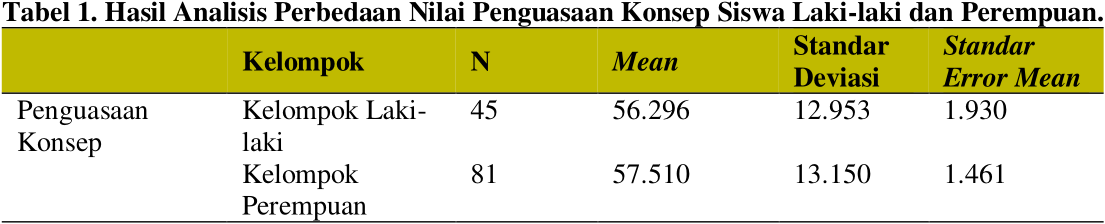
Mastery of concepts in a field of science includes a combination of mastery of knowledge of the field of science being studied and dimensions of cognitive processes, including factual, conceptual and procedural knowledge. The importance of students' mastery of concepts related to the field of biology means that teachers must continue to train students to master biological concepts well. In general, social studies students have good knowledge in the field of social studies, but not necessarily good knowledge in the field of science, especially biology. The aim of this research is to reveal gender-based mastery of biology concepts of students majoring in social studies at SMA Negeri 7 Mataram using a project based learning model. The research method used quasi correlational involving 126 students, consisting of 45 male students and 81 female students. Data analysis used an independent sample t test at a significance level of 5%. The research results show that there is no significant difference between male and female students' mastery of concepts using the project based learning model. The average mastery of concepts for male students is 56.296, and the average mastery of concepts for female students is 57.510. The significance value (Sig. 2 tailed) is 0.618 > 0.05. The implication of this research is that the project based learning model does not provide a significant difference in students' mastery of concepts based on gender, or the project based learning model can be said to have the same effect in increasing students' mastery of biology concepts, both for male and female students.
Downloads
References
Abdullah, S., & Shariff, A. (2008). The Effects of Inquiry-Based Computer Simulation with Cooperative Learning on Scientific Thinking and Conceptual Understanding of Gas Laws. Eurasia Journal of Mathematics, Science and Technology Education, 4(4), 387-398. https://doi.org/10.12973/ejmste/75365
Abdurrahman., Liliasari., Rusli, A., & Waldrip, B. (2011). Implementasi Pembelajaran Berbasis Multi Representasi untuk Peningkatan Penguasaan Konsep Fisika Kuantum. Cakrawala Pendidikan, 1(1), 30-45. https://doi.org/10.21831/cp.v1i1.4189
Amin, A. M., Corebima, A. D., Zubaidah, S., & Mahanal, S. (2016). Pre-Motivational Study Based Arcs (Attention, Relevance, Confidence, and Satisfaction) at Biology Education Students at Physiology Animal Lecture. In International Conference on Education 2016 (pp. 116-124). Malang, Indonesia: Universitas Negeri Malang.
Anderson, L. W., Krathwohl, D. R., Airasian, P. W., Cruikshank, K. A., Mayer, R. E., Pintrich, P. R., Raths, J., & Wittrock, M. C. (2001). A Taxonomy for Learning, Teaching, and Assessing: A Revision of Bloom’s Taxonomy of Educational Objectives. New York: Longman.
Aprilia, N. (2015). Pengaruh Aktivitas dan Gaya Belajar Mahasiswa terhadap Pemahaman Konsep pada Mata Kuliah Perkembangan Peserta Didik. In Symposium on Biology Education (pp. 61-68). Yogyakarta, Indonesia: Universitas Ahmad Dahlan.
Astriani, D., Martini., Rosdiana, L., Fauziah, A. N. M., & Purnomo, A. R. (2023). STEAM-Project Based Learning (PjBL): Efforts to Train Critical Thinking Skills for Prospective Science Teacher. Jurnal Penelitian Pendidikan IPA, 9(10), 7909-7915. https://doi.org/10.29303/jppipa.v9i10.3823
Bell, C. V., & Odom, A. L. (2012). Reflections on Discourse Practices During Professional Development on the Learning Cycle. Journal of Science Teacher Education, 23(6), 601-620. https://doi.org/10.1007/s10972-012-9307-y
Chang, C. -Y. (2010). Does Problem Solving = Prior Knowledge + Reasoning Skills in Earth Science? An Exploratory Study. Research in Science Education, 40(2), 103-116. https://doi.org/10.1007/s11165-008-9102-0
Fitria, Y., Safnowandi., & Fajri, S. R. (2022). Pengaruh Model Pembelajaran Inkuiri Terbimbing (Guided Inquiry) Berbasis Saintifik terhadap Kemampuan Berpikir Kritis Siswa. Biocaster : Jurnal Kajian Biologi, 2(3), 128-141. https://doi.org/10.36312/bjkb.v2i3.97
Harto, N., Sarwi., Sudarmin., & Supriyadi. (2019). Effectiveness of the Project Based Learning Model Integrated Ethno Technology to Actualize Superior Teacher Candidates. In Proceedings of the 1st International Conference on Education and Social Science Research (ICESRE 2018) (pp. 58-62). Amsterdam, Belanda: Atlantis Press.
Hubber, P., Tytler, R., & Haslam, F. (2010). Teaching and Learning About Force with a Representational Focus: Pedagogy and Teacher Change. Research in Science Education, 40(1), 5-28. https://doi.org/10.1007/s11165-009-9154-9
Krathwohl, D. R. (2002). A Revision of Bloom’s Taxonomy. Theory into Practice, 41(4), 212-219. https://doi.org/10.1207/s15430421tip4104
Kuo, H. C., Tseng, Y. C., & Yang, Y. T. C. (2019). Promoting College Student’s Learning Motivation and Creativity Through a STEM Interdisciplinary PBL Human-Computer Interaction System Design and Development Course. Thinking Skills and Creativity, 31(September), 1-10. https://doi.org/10.1016/j.tsc.2018.09.001
Lou, S. J., Chou, Y. C., Shih, R. C., & Chung, C. C. (2017). A Study of Creativity in CaC 2 Steamship-Derived STEM Project-Based Learning. Eurasia Journal of Mathematics, Science and Technology Education, 13(6), 2387-2404. https://doi.org/10.12973/EURASIA.2017.01231A
Rezeki, R. D., Nurhayati, N. D., & Mulyani, S. (2015). Penerapan Metode Pembelajaran Project Based Learning (PjBL) Disertai dengan Peta Konsep untuk Meningkatkan Prestasi dan Aktivitas Belajar Siswa pada Materi Redoks Kelas X-3 SMA Negeri Kebakkramat Tahun Pelajaran 2013/2014. Jurnal Pendidikan Kimia, 4(1), 74-81.
Schönborn, K. J., & Bögeholz, S. (2009). Knowledge Transfer in Biology and Translation Across External Representations: Experts’ Views and Challenges for Learning. International Journal of Science and Mathematics Education, 7(5), 931-955. https://doi.org/10.1007/s10763-009-9153-3
Taşlıdere, E. (2013). Effect of Conceptual Change Oriented Instruction on Students’ Conceptual Understanding and Decreasing Their Misconceptions in DC Electric Circuits. Creative Education, 04(04), 273-282. https://doi.org/10.4236/ce.2013.44041
Treagust, D. F., & Tsui, C. -Y. (2013). Models and Modeling in Science Education : Multiple Representations in Biological Education. Berlin: Springer International Publishing.
Wulandari, S., Suarsini, E., & Ibrohim. (2016). Pemanfaatan Sumber Belajar Handout Bioteknologi Lingkungan untuk Meningkatkan Pemahaman Konsep Mahasiswa S1 Universitas Negeri Malang. Jurnal Pendidikan : Teori, Penelitian, dan Pengembangan, 1(5), 881-884. https://doi.org/10.17977/jp.v1i5.6297
Downloads
Published
How to Cite
Issue
Section
License
Copyright (c) 2024 Baiq Muli Harisanti, Any Fatmawati, Titi Laily Hajiriah, & I Wayan Karmana

This work is licensed under a Creative Commons Attribution-ShareAlike 4.0 International License.
-
Attribution — You must give appropriate credit, provide a link to the license, and indicate if changes were made. You may do so in any reasonable manner, but not in any way that suggests the licensor endorses you or your use.
-
ShareAlike — If you remix, transform, or build upon the material, you must distribute your contributions under the same license as the original.